

High temperature melt pressure sensors play a crucial role in industries such as petrochemicals, plastic processing, and metal smelting. These sensors not only need to operate stably in extreme high temperature environments, but also need to accurately convert the pressure changes of the melt into electrical signals for real-time monitoring and adjustment by the control system. Among them, 4-20mA current signal is highly favored as a standardized industrial process control signal due to its strong anti-interference ability and long transmission distance.
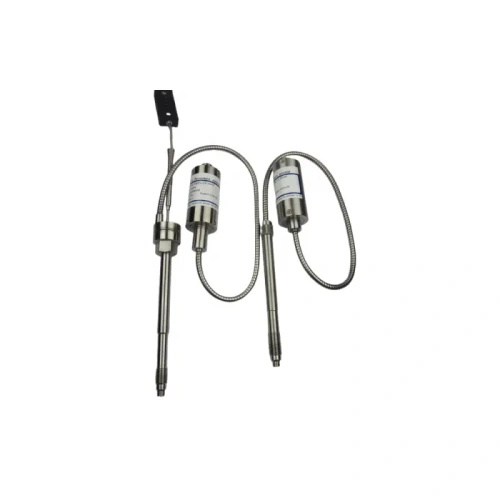
Taking SPX-L3242 high-temperature melt pressure sensor as an example, this sensor not only has a fully welded structure, explosion-proof and non flammable, but also meets the requirements of CE-PED European standards. Its input voltage range is 16-32Vdc, and its output is a standard 4-20mA analog signal. At the same time, it can also be equipped with HART digital signal output. In terms of comprehensive accuracy, the sensor can achieve an accuracy of ± 0.25% full scale (3M and above) or ± 0.35% full scale (1.5M and below) within the range of 20-100% full scale. Of particular note is that its temperature drift is only 0.001% of full scale/℉ within the range of 77-572 ℉ (25-300 ℃), thanks to its built-in temperature compensation system.
The role of high-temperature melt pressure sensors is particularly prominent in plastic extrusion and injection molding processes. Plastic raw materials are heated to a molten state in extruders or injection molding machines, and the pressure change of the melt has a crucial impact on product quality and production efficiency. Through a 4-20mA current signal, the high-temperature melt pressure sensor can transmit the melt pressure in real time to the control system. The control system adjusts the screw speed, heating temperature, etc. of the extruder or injection molding machine according to preset parameters, thereby ensuring the dimensional accuracy, surface quality, and production efficiency of plastic products.
In the field of metal smelting, high-temperature melt pressure sensors also play an important role. Taking aluminum smelting as an example, aluminum liquid is melted at high temperature in the electrolytic cell, and the pressure change of the melt has a direct impact on the stability of the electrolysis process and the quality of the aluminum liquid. By using a high-temperature melt pressure sensor and a 4-20mA current signal, the pressure changes of the aluminum liquid can be monitored in real time, and the parameters such as current and voltage of the electrolytic cell can be adjusted as needed to ensure the quality of the aluminum liquid and the stability of the electrolysis process.
In addition, with the continuous development of Industry 4.0 and IoT technology, high-temperature melt pressure sensors are gradually realizing intelligence and networking. Through seamless integration with factory automation systems, sensors can upload real-time data to the cloud or local servers for remote monitoring and analysis by production management personnel. This not only improves production efficiency and quality, but also reduces production costs and energy consumption.
High temperature melt pressure sensors and their 4-20mA current signals are widely used and important in the industrial field. They not only ensure the stability of the production process and product quality, but also promote the development of industry towards intelligence and networking. With the continuous advancement and innovation of technology, high-temperature melt pressure sensors will play a more important role in the future.