

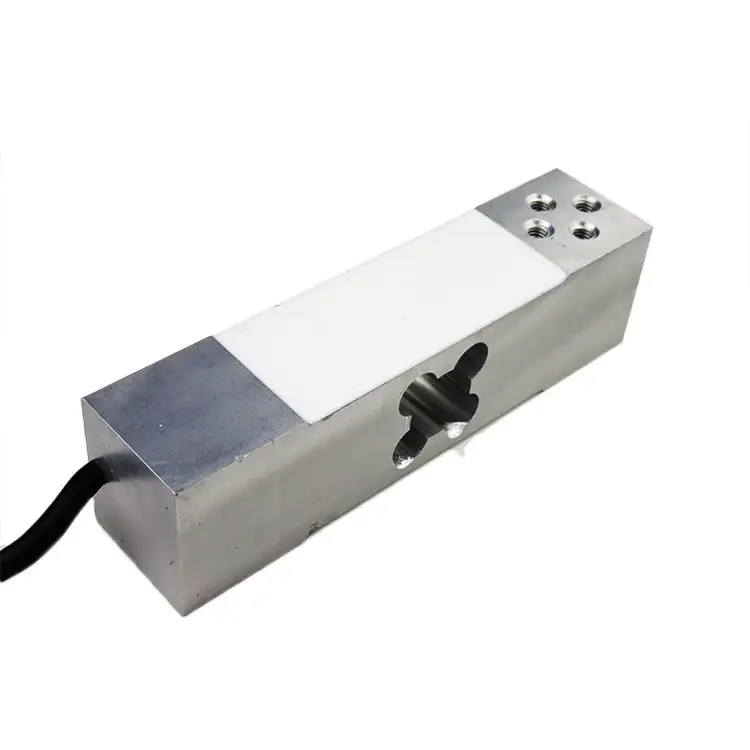
Force sensors are designed to measure mechanical force, which is fundamentally defined as an interaction that causes an object to change motion or deform. The most widely used unit for measuring force sensors is the Newton (N), which belongs to the International System of Units (SI). One Newton represents the force required to accelerate a one-kilogram mass at one meter per second squared. In most engineering, robotics, and automation systems, force sensor output is calibrated in Newtons because it provides a standardized and scientifically consistent reference.
However, Newtons are not the only units commonly encountered in force sensor applications. In many industrial environments, especially where traditional mechanical systems are still used, force sensors may also be specified in kilogram-force (kgf) or pound-force (lbf). Kilogram-force represents the force exerted by gravity on a one-kilogram mass, while pound-force is based on the gravitational force acting on a pound-mass. These units are still widely used in regions where legacy systems or operator familiarity play an important role, particularly in industrial force sensor installations involving presses, assembly lines, or material testing equipment.
For high precision force sensor applications, such as semiconductor manufacturing, medical devices, or research laboratories, unit consistency becomes even more critical. Engineers often prefer Newtons or even milli-Newtons (mN) and micro-Newtons (µN) to capture very small force changes. In these environments, even minor unit conversion errors can lead to inaccurate measurements, compromised product quality, or failed compliance tests. This is why many companies choose to work with a custom force sensor manufacturer who can calibrate sensors precisely in the required unit and range.
Another important consideration is that force sensors do not simply “output” force units on their own. Internally, most force sensors measure strain, deformation, or electrical resistance changes, which are then converted into force units through calibration. This conversion process depends heavily on the chosen unit. For example, an industrial force sensor calibrated in Newtons may display different resolution and sensitivity characteristics compared to the same sensor calibrated in kgf, even though the physical sensing element is identical. Selecting the correct unit at the calibration stage ensures that the sensor provides meaningful, easy-to-interpret data for the end user.
In global supply chains, unit selection also impacts communication between teams and suppliers. A force sensor specified in lbf may cause confusion when integrated into systems designed around SI units. For this reason, international manufacturers increasingly standardize on Newton-based measurements, especially when working with a custom force sensor manufacturer serving global markets. This reduces the risk of conversion errors and improves system compatibility across regions.
In industrial automation, force sensors are often used to monitor pressing force, insertion force, clamping force, or tension. In these cases, force ranges are typically larger, and units like Newtons or kilo-Newtons (kN) are common. An industrial force sensor designed for such applications must be robust enough to handle high loads while maintaining consistent output in the selected unit. Accurate unit selection helps operators quickly identify abnormal force conditions and protect equipment from overload.
For buyers comparing suppliers, understanding force measurement units can also help evaluate technical competence. A manufacturer that clearly explains unit calibration, conversion accuracy, and output scaling demonstrates deeper expertise. This is one reason many OEMs prefer partnering with a custom force sensor manufacturer who can provide application-specific guidance rather than offering only generic specifications.
Ultimately, the unit used to measure a force sensor is more than a label—it is a key part of system design, accuracy, and usability. Whether you need a high precision force sensor for delicate measurements or a rugged industrial force sensor for heavy-duty environments, selecting the appropriate force unit and ensuring correct calibration will significantly impact performance and reliability.